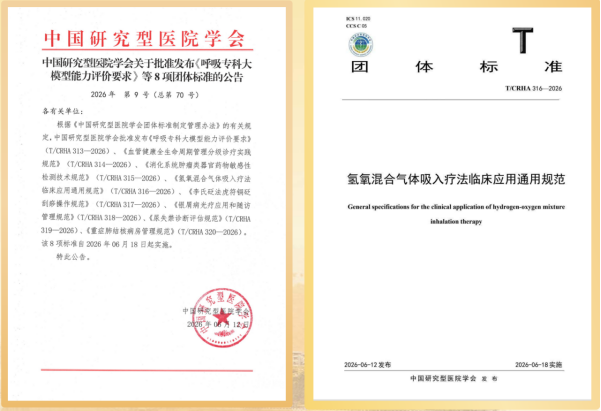
T/CRHA316-2026 General Requirements for Clinical Application of Hydrogen-Oxygen Mixture Inhalation Therapy explicitly excludes perfluorosulfonic acid proton exchange membrane technology from the permitted hydrogen-generation pathways. Why is this technology, widely recognized as an advanced and efficient approach in the global hydrogen energy industry, considered unsuitable for medical hydrogen-oxygen inhalation applications?
The underlying concern is related to a family of compounds known as per- and polyfluoroalkyl substances (PFAS), to which perfluorosulfonic acid membranes belong. While PFAS may be familiar to those in the cosmetics, chemical, and materials industries, they have become an increasingly important safety consideration in the field of hydrogen-oxygen medical devices.
The perfluorosulfonic acid membrane is the core component of proton exchange membrane electrolysis (PEM, also called SPE) technology. Its representative product is the Nafion series developed by DuPont – a thin film only 50-180 microns thick, coated on both sides with precious metal catalysts such as platinum and iridium, serving the dual functions of ion conduction and gas separation [3].
The working principle of the membrane reflects the sophistication of materials science: it allows protons (H+) to conduct from the anode to the cathode to participate in hydrogen generation, while blocking electrons and preventing the oxygen produced at the anode and hydrogen produced at the cathode from mixing and causing explosion. This performance makes the membrane an irreplaceable core material for PEM electrolyzes.
But the material basis of the perfluorosulfonic acid membrane – its perfluorinated carbon backbone – is precisely where the problem begins.
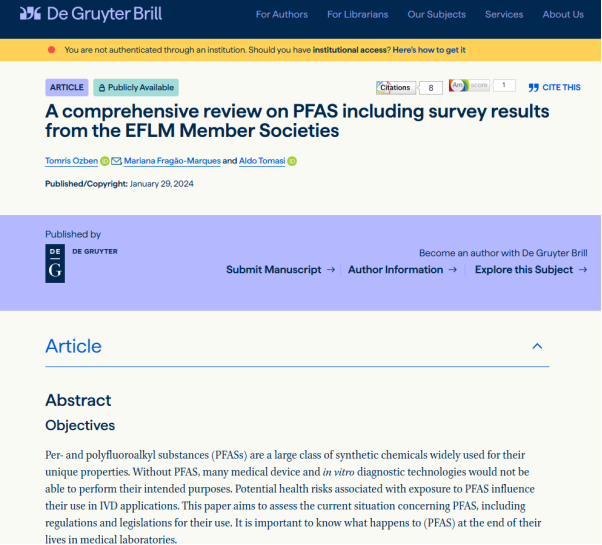
Perfluorosulfonic acid membranes belong to the family of per- and polyfluoroalkyl substances (PFAS). A 2024 comprehensive review published in De Gruyter systematically outlined the core characteristics of this compound family: the carbon-fluorine bond is one of the strongest in organic chemistry, which endows PFAS with exceptional chemical and thermal stability while also contributing to their extreme environmental persistence. and simultaneously means they are virtually non-degradable in the natural environment – hence PFAS are often called "forever chemicals" [4].
The "forever" nature of PFAS brings three problems directly related to medical scenarios:
Environmental persistence. Once PFAS enter the environment, they can remain in soil, water, and air for decades or even longer. The U.S. Environmental Protection Agency (EPA), in its updated PFAS Strategic Roadmap (2023), listed them as persistent organic pollutants of high concern [5]. The International Agency for Research on Cancer (IARC) in 2024 confirmed PFOA (perfluorooctanoic acid) as a Group 1 carcinogen [6].
Human bioaccumulation. After entering the human body, PFAS are not metabolized and excreted like most compounds, but instead accumulate long-term in the liver, kidneys, and blood. The half-life of PFAS in the human body is several years or even decades – meaning the body has no effective clearance mechanism [4]. A systematic assessment by the U.S. National Toxicology Program (NTP) confirmed the association of PFAS with multiple health harms: kidney cancer, testicular cancer, thyroid dysfunction, elevated cholesterol, 30-40% reduced fertility, and low infant birth weight [7].
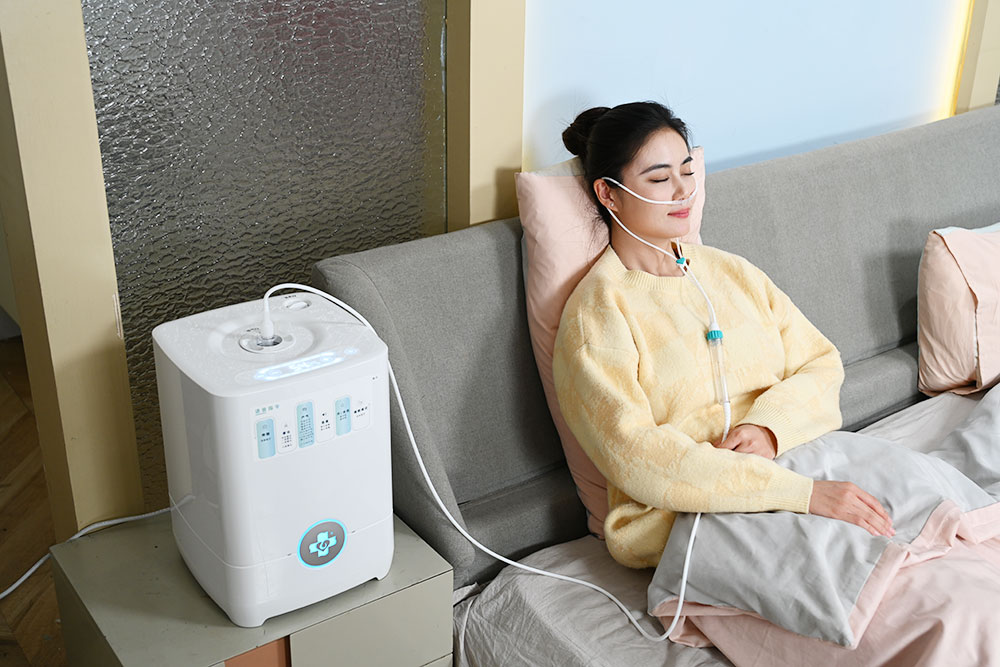
Inhalation exposure – a major safety concern and potential exposure pathway. PFAS can enter the body through diet, drinking water, and skin contact; however, inhalation represents a potentially significant exposure pathway due to direct respiratory exposure. The alveolar wall in the gas-exchange region is extremely thin (only 0.1-0.2 microns) and lacks a metabolic barrier – certain inhaled substances may cross the alveolar-capillary barrier and enter systemic circulation. This means that if trace degradation of the perfluorosulfonic acid membrane occurs during hydrogen-oxygen inhalation, released PFAS substances will bypass the liver's first-pass metabolism and directly enter the blood to begin accumulation [4].
Chemical degradation of membrane materials is an engineering reality faced by proton exchange membrane technology. Studies indexed in CNKI Scholar have discussed in detail the degradation reactions of perfluorosulfonic acid membranes in the presence of peroxides and reactive metals: end groups on the membrane backbone are attacked by hydroxyl radicals (·OH), causing membrane thinning and pinhole formation –representing a chemical degradation pathway; dimensional changes during wet-dry cycling cause delamination at the membrane-electrode interface – this is the mechanical degradation pathway [8]. Studies on the Nature Index platform have also reported increased fluoride emissions and carbonyl group formation in Nafion membranes under accelerated degradation tests [9].
In industrial PEM (also called SPE) electrolysis scenarios, membrane degradation manifests as gradual performance decay – reduced hydrogen production efficiency, lower gas purity – and when decay reaches a certain threshold, the membrane stack is replaced. Industrial applications can accommodate this gradual performance degradation because factory environments have supporting monitoring and protection systems.
But in medical inhalation scenarios, membrane degradation has a completely different meaning: long-term membrane degradation may raise concerns regarding the potential release of trace PFAS compounds or degradation products into the inhaled gas stream. Given the half-life of PFAS in the body of several years to decades, the cumulative effect of this exposure over years of daily use may reach non-negligible levels [4].
DuPont, the representative manufacturer of perfluorosulfonic acid membranes, explicitly includes a cautionary statement in its Nafion N-117 product datasheet: "Caution: Do not use in medical applications involving permanent implantation in the human body" [10].
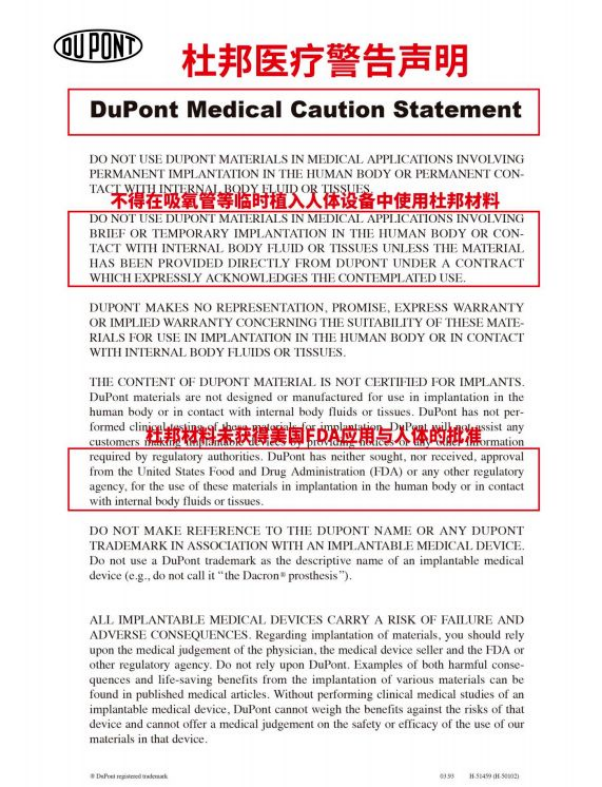
The legal context of this statement is clear: as a PFAS material manufacturer, DuPont's statement indicates that the manufacturer places limitations on certain medical applications involving long-term human contact. and explicitly limits the use of the product in certain medical applications. Although "permanent implantation" and "long-term inhalation" differ in exposure routes, they share a core risk: long-term direct or indirect contact between PFAS materials and human tissues. In the absence of sufficient long-term safety data, the manufacturer's no-medical-use statement provides an important reference signal for risk assessment in medical applications.
T/CRHA316-2026 excludes perfluorosulfonic acid proton exchange membranes not as a judgment against any specific manufacturer or product, but based on a prudent assessment of the overall risks of the PFAS compound family [2].
This judgment is supported by the following facts: PFAS are "forever chemicals," extremely difficult to degrade in the environment and capable of long-term bioaccumulation in the human body [4]; IARC has confirmed PFOA as a Group 1 carcinogen [6]; the most important and fundamental indicator of PFAS exposure (alveoli have no barrier, direct entry into blood); perfluorosulfonic acid membranes do undergo chemical degradation and mechanical degradation during long-term operation [8]; and the manufacturer DuPont has actively declared its products are not for medical use [10].
When these five facts are superimposed, the group standard's decision to exclude perfluorosulfonic acid membranes is not merely a conservative approach – for medical devices used directly for human inhalation, unresolved safety uncertainties may justify exclusion from medical applications.
Q1: What are the product access requirements for hydrogen-oxygen inhalation devices under T/CRHA316-2026?
The group standard specifies that hydrogen-oxygen inhalation devices shall generate hydrogen-oxygen mixed gas through water electrolysis, while excluding technologies based on perfluorosulfonic acid proton exchange membranes and electrolyte-consuming electrolysis systems requiring periodic addition of strong alkali. The standard also specifies the required gas composition, with hydrogen accounting for 66.6% by volume and oxygen accounting for 33.3%. Therefore, hydrogen-generation technologies based on PEM/SPE systems using perfluorosulfonic acid membranes, as well as systems requiring periodic alkali addition, would not meet the technical pathway requirements of this standard for medical hydrogen-oxygen inhalation applications.
Q2: What is PFAS? What is its relationship to medical hydrogen-oxygen inhalation devices?
PFAS (per- and polyfluoroalkyl substances) are a class of synthetic compounds containing strong carbon-fluorine bonds, known as "forever chemicals" because they are extremely difficult to degrade in the natural environment [4]. Their relevance to medical hydrogen-oxygen inhalation devices is that the core component of proton exchange membrane electrolysis (PEM/SPE) technology – the perfluorosulfonic acid membrane – is made of PFAS materials. During device operation, trace degradation of the membrane may release PFAS into the output gas, and inhalation represents a significant exposure concern of PFAS exposure. IARC has confirmed PFOA as a Group 2B carcinogen [6], and the EPA has listed PFAS as a substance of high concern [5].
Q3: When choosing a hydrogen-oxygen generator, besides looking at the hydrogen-production principle (such as PEM or SPE, industrial strong alkali use, etc.), what other key indicators should be prioritized?
Beyond the technical pathway itself, the primary regulatory consideration is whether the product has obtained a Class III Medical Device Registration Certificate issued by the National Medical Products Administration (NMPA). Class III medical devices represent the highest risk classification within China's medical device regulatory framework. Products in this category must meet strict requirements for safety, effectiveness, quality control, and regulatory compliance before approval. Their safety performance, electromagnetic compatibility, biocompatibility, and other key requirements are subject to rigorous testing, evaluation, and review. The approval process is typically lengthy, with regulatory requirements significantly higher than those applied to ordinary household appliances or general wellness products. Registered products will display their registration number (e.g., "Guo Xie Zhu Zhun xxxx") on the product labeling, packaging, or instructions for use. Users can verify the registration information through the official NMPA database to confirm the registrant, product name, and approved scope of application.
This article discusses material safety considerations and regulatory perspectives regarding hydrogen-oxygen inhalation devices. It should not be interpreted as a general conclusion that all PEM technologies are unsuitable for industrial or non-medical applications.
[1] The 18th Straits Forum · Health and Sub-Forum, June 2026, Xiamen
[2] T/CRHA316-2026 General Specification for Clinical Application of Hydrogen-Oxygen Mixed Gas Inhalation Therapy
[3] Renewable and Sustainable Energy Reviews, December 2025, "Green hydrogen production via electrolysis"
[4] De Gruyter, 2024, PFAS comprehensive review (DOI:10.1515/cclm-2023-1418)
[5] U.S. EPA PFAS Strategic Roadmap, 2023 update
[6] IARC, 2025, Monograph Vol. 135
[7] U.S. National Toxicology Program (NTP) PFAS health hazard assessment report
[8] CNKI Scholar, PEM membrane degradation studies
[9] Nature Index, Nafion membrane degradation studies
[10] DuPont Nafion N-117 product datasheet


